- Launch
- ASO
- App Store
App Store new app boost: what the data shows and what to do
The App Store new app boost explained: what Apple and Google say, what launch rank data shows, how to measure it, and a four-week plan for your launch window.
AppRanker team12 min read

On this page
The App Store new app boost is the idea that Apple and Google lift a brand-new app in search for its first days or weeks, then let it fall back to where its downloads and ratings put it. Almost every indie developer who launches an app sees something that looks like it: a busy first few days, then a slide. The question that matters for your launch plan is whether that curve comes from the store's ranking, or from the people you brought with you. The answer changes what you should do in week one.
This guide collects what Apple and Google have actually said, what ASO vendors claim, and what the one public rank study of 2026 launches found. Then it turns that into a way to measure your own launch and a four-week plan for the window when your app is new.
Key takeaways
- Neither Apple nor Google documents a new app boost. Apple says search ranking uses text relevance and "user behavior (downloads, ratings and reviews, and more)", with nothing specific to new apps.
- ASO vendors describe a temporary uplift lasting "a few days to a few weeks". A tracking study of 34 iOS apps launched in 2026 found no measurable lift in keyword ranks.
- The launch spike most developers see is mostly outside traffic (launch posts, friends, testers, pre-orders) that fades within two or three weeks.
- Measure it: split first-time downloads by source in App Store Connect and Play Console, and judge your organic baseline from about week 3.
- Plan the window around sustained outside traffic and stable metadata, not around a boost you cannot verify.
What people mean by the new app boost
The claim comes in two versions. The strong version says the store gives every new app a temporary ranking bonus, a kind of grace period in search. The weak version says new apps naturally collect a burst of downloads in launch week, and the ranking algorithm rewards that burst the way it rewards any burst.
ASO vendors mostly state the strong version. SplitMetrics, in its App Store ranking factors guide from September 2025, writes that "new apps on the App Store often receive a temporary uplift in organic rankings" which "can last anywhere from a few days to a few weeks after launch", and adds that "updated apps won't observe this effect". MobileAction's ranking factors post leans on the weak version: "App Store's algorithm views strong download momentum as evidence of user interest."
Indie developers describe it in plainer terms. On ASO forums the "honeymoon period" usually means three days to a week of decent downloads, followed by a drop that feels like a penalty.
What Apple and Google actually say
Apple's App Store search page is the closest thing to an official description of ranking, and it says nothing about launch dates:
"Search results are based on a number of factors, including text relevance (matches for your app's title, subtitle, keywords, and primary category), as well as user behavior (downloads, ratings and reviews, and more)."
The same page does mention newness once, as a disadvantage. Popular terms "may drive a lot of traffic, but are highly competitive – especially if you are a newer or smaller app. Less common terms drive lower traffic, but are less competitive." That is advice to pick winnable keywords, not a promise of a launch bonus.
Google has published no new app boost either. What both stores do publish is a list of things you must not do to fake momentum. Apple's App Review Guideline 5.6.3 bans "manipulating any element of the App Store customer experience such as charts, search, reviews, or referrals to your app", and Google's User Ratings, Reviews, and Installs policy forbids attempts to "manipulate the placement of any apps on Google Play". If a boost depends on early downloads, it has to be earned with real ones.
For a fuller list of what the stores confirm about ranking, see our guide to app store ranking factors.
What launch rank data shows
The most careful public look at this is a study published on October 23, 2026 by Sonar, an ASO keyword tool: New app boost: does the App Store give one?. It followed 34 iOS apps released between March 1 and July 28, 2026, and compared them with 72 established small apps that had fewer than 1,000 ratings.
What it found:
- For each new app's five best non-brand keywords, the median rank change stayed within three places of the starting point through week 8. The established apps moved within one place.
- New apps were more likely to slip than established ones: 19 to 30% of new apps fell 10 or more places in a given week from week 1 to week 8, against 6 to 18% of the control group.
- Updates were not a lever on their own. Across 218 iOS releases, 9.9% of keywords improved by 20% or more in the week after a release, against 10.8% in an ordinary week.
The author is clear about the limits: tracking usually started around day 5, the study measured keyword ranks rather than downloads, Browse and featuring were not measured, and only 14 Google Play apps were tracked, too few to conclude anything for Android. "Apple doesn't document a new app boost, and it doesn't document the absence of one either."
So the honest summary is narrow. If a boost exists, it does not show up as a lift in the keyword ranks a small app actually competes for. That leaves the launch-week curve to be explained by something else.
A launch-week download chart often looks like this. The question is whether the spike came from store search or from the links you shared. Photo: ThisIsEngineering / Pexels
Why downloads spike and then fall after launch
Think about who downloads a new app in its first three days:
| Source | Launch week | By week 3 |
|---|---|---|
| Your launch posts on social sites and forums | A burst on each day you post | A trickle from old threads |
| Friends, beta testers and your mailing list | Almost all in the first few days | Nothing new |
| Pre-orders and pre-registrations | Arrive together on release day | Nothing new |
| Store search | What your keyword ranks earn | About the same as week 1 |
| Store browse and featuring | Only if an editor picked you | Ends when the feature does |
Sonar's post splits launch traffic the same way.
Most of that first wave is people who already knew about the app. When they have installed it, the curve falls to whatever store search sends you, which for a new app with no ratings is usually small. That drop is real, but it is not the store taking a bonus away. It is the end of your own launch traffic.
That reading also explains why vendors who believe in the boost and the study that found none can both be partly right. A big outside burst can lift an app in charts and in search for a while because downloads are a ranking input, as Apple's own wording says, and vendors argue that the pace of downloads counts as well. It just does not happen by default for every new app, and a small burst does not move much.
How to check whether your app got a boost
You do not have to take anyone's word for it. Both consoles split downloads by source.
On the App Store
In App Store Connect, open Analytics, then Acquisition, and look at first-time downloads by source type. Apple defines them on its acquisition sources page:
- App Store search: "Users viewed your app or downloaded it from search on the App Store", including Apple Ads in search results.
- App Store browse: users who found you while browsing, "for example, in the Today, Games, or Apps sections".
- Web referrer: users who "tapped a link from a website" in Safari.
- App referrer: links tapped inside other apps. On iOS, taps from Chrome and other non-Safari browsers land here as that browser app.
If launch week is dominated by web and app referrers and search stays flat, you had a launch spike, not a search boost. Our guide to App Store Connect analytics walks through the reports in more detail.
On Google Play
In Play Console, the store listing acquisition report separates Google Play search, Google Play explore and Ads and referrals. Links you tag with utm_source and utm_campaign show up under Ads and referrals with those values, which is how you see which launch post actually sent installs (Play Console Help).
A weekly table worth keeping
Write one row per week for the first eight weeks:
| Week | Search downloads | Browse downloads | Referral downloads | Ratings received | Metadata changed? |
|---|---|---|---|---|---|
| 0 (launch) | |||||
| 1 | |||||
| 2 | |||||
| 3 |
Search downloads in weeks 3 to 8 are your organic baseline. Sonar's advice matches what the table will show you: "measure your organic baseline from about week 3 onward, once the launch posts have stopped sending traffic." If you also track keyword positions, our guide on App Store keyword ranking shows how to check them for free.
A four-week plan for the launch window
Whether or not the store helps, the first month is when your app has the most attention it will get for a while. Use it so that the attention outlasts the launch posts.
Before launch: lock the metadata
- Ship your final keywords in the launch version. On the App Store, the keyword field (100 bytes) belongs to the version you submit, so a change means a new submission. Do the research first; our guide to ASO keyword research without paid tools covers it with free data.
- Target terms you can rank for. Apple's own advice above applies twice to a new app: long, specific phrases first, head terms later.
- Nominate the app for featuring. Apple asks for "a minimum lead time of 3 weeks" for nominations, and has an App Launch nomination type (featuring nominations). Our guide on how to get featured on the App Store covers what to write. Google Play's featuring nomination form wants "eight weeks for newly launched apps", so start that one even earlier.
- Pick the release day on purpose. Use manual release so approval and launch are separate events. Our guide to the best time to launch an app covers day, hour and season.
Week 0 and 1: spread the traffic out
- Do not fire every channel on day one. A single spike that collapses tells the algorithm less than steady downloads across the first two weeks. Stagger your posts: communities on day one, a newsletter or Show HN a few days later, a write-up of early lessons at the end of the week.
- Ask for ratings at the right moment. Use the native prompt after a success, not on first launch. Apple says you can prompt "up to three times in a 365-day period" (Requesting App Store reviews); on Android, the Google Play In-App Review API has its own quota. Ratings are one of the user-behaviour signals Apple names.
- Write announcements that people can act on. Our app launch announcement templates cover social posts, email and a short press note.
Weeks 2 and 3: add sources that do not fade
The launch posts will stop sending traffic. Before they do, add placements that stay up: directories with a permanent listing, a page on your website with the store badges, and leaderboards. Our list of where to submit your app compares the options.
Week 4: first metadata decision
Read your table. If search downloads hold steady from week 3, your keywords work and you can start testing a broader term. If they are close to zero, change the keywords in your next version rather than the screenshots: the store has to show your app before anyone can judge its product page. Sonar's suggestion to "pick a date three to four weeks out to make your first metadata decision" is a good default, because changing everything in week one makes the results impossible to read.
Where a leaderboard listing fits
A launch post is gone from the feed in a day. A placement that stays where people browse for new software keeps sending the occasional visitor after week 3, which is exactly when the launch spike has faded and your organic baseline is still small.
That is the job AppRanker is built for. It is a pay-to-rank leaderboard for App Store, Google Play and browser extension listings, an Outbid alternative for apps and extensions: paste your store link, pay $5 at the time of writing to join, and your app gets a row on the board, a listing page of its own and a share card. Rank is a plain sort on what each listing has paid, with no algorithm in between, and a listing's total never decays. New listings also appear in the New arrivals section of the home page.
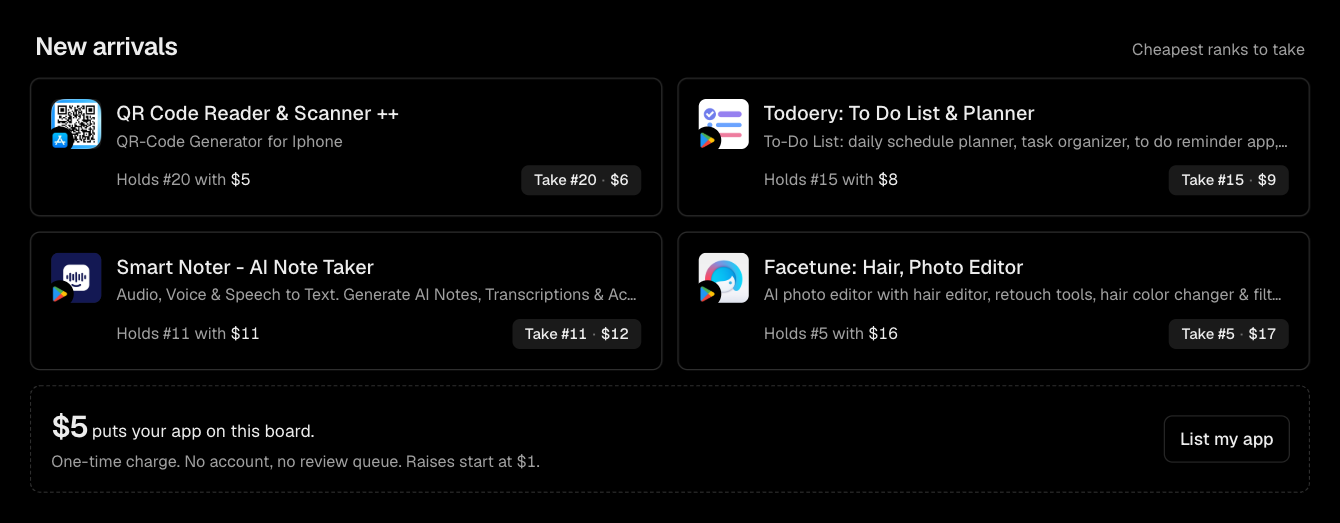
New listings show up in New arrivals with their place and the price of the next one up.
Be clear about what it is. A position buys visibility, not installs, and AppRanker makes no traffic promises; our post on what a paid leaderboard position buys covers the limits. Every row links straight to your store page, so any downloads it sends are real people who chose to install, which is the only kind of launch momentum the store rules allow. If that fits your plan, you can put your app on the leaderboard and see every position's price before you pay.
What not to do in the launch window
- Do not buy installs or ratings. Guideline 5.6.3 and Google's installs policy both cover it, and Apple's guidelines warn that inflating rankings with "paid, incentivized, filtered, or fake feedback" can get you expelled from the developer program.
- Do not reset the clock with constant updates. The Sonar data found no extra rank movement after a release; the movement comes from what you change.
- Do not read week-one numbers as your baseline. They tell you how well your launch posts worked, not how well your listing ranks.
- Do not change keywords, screenshots and price all at once. You will not know which change did what.
New app boost checklist
- Final keywords researched and shipped in the launch version
- Featuring nomination submitted at least three weeks ahead
- Manual release selected and launch day chosen
- Campaign links and UTM tags on every link you share
- Launch posts staggered across the first two weeks
- Rating prompt placed after a success, not at first launch
- At least two placements that stay up after launch week
- Weekly table of downloads by source kept for eight weeks
- First metadata change scheduled for week 4, not week 1
FAQ
Does the App Store give new apps a boost?
Apple does not document one. Several ASO vendors describe a temporary uplift lasting days to weeks, but a 2026 study of 34 new iOS apps found no measurable lift in their keyword ranks. The launch-week rise most developers see is mostly traffic they brought themselves.
How long does the App Store honeymoon period last?
Developers usually describe three days to a week. That matches how long launch posts, friends and testers keep sending downloads. Judge your real organic level from about week 3.
Does Google Play have a new app boost?
Google has not documented one, and there is too little public data to say. A brand-new Play app has no installs, ratings or retention data for the store to work with yet, so quiet early weeks are normal.
Why did my downloads drop after launch week?
Most likely because your launch traffic ran out, not because the store took something away. Check the source split in App Store Connect or Play Console: if referrals fell and search stayed flat, that is the explanation.
Do app updates give a ranking boost?
Not by themselves. The 2026 Sonar data showed keyword movement after an iOS release was about the same as in an ordinary week. New keywords, a better title or more ratings can move rank; a version number cannot.
Should I change my keywords in the first week?
Usually not. Ship researched keywords at launch, then wait three to four weeks so you can read the result before changing anything.
Image credits
- Cover, rocket launch above palm trees: photo by SpaceX on Pexels, Pexels License. Cropped to 1200x630.
- Line graph on a laptop screen: photo by ThisIsEngineering on Pexels, Pexels License. Resized.