- Ranking
- Bidding
- How it works
How AppRanker ranks apps: a plain sort on what each listing has paid
AppRanker rank is a descending sort on what each listing has paid. How totals, ties, raises and outbids work, with no algorithm in between.
AppRanker team5 min read
On this page
Most places that rank software ask you to trust a formula you cannot see. Store search weighs installs, ratings, retention and whatever else the store has decided matters this quarter. Curated lists depend on who happened to be looking. AppRanker does the opposite: the whole ranking rule fits in one sentence, and it is printed on the home page.
Ranked by dollars, not by algorithm.
This post walks through that rule in full, because a leaderboard is only worth anything if everyone reading it knows exactly what the order means.
The rule: rank is the total paid, highest first
Every listing on the board has one number attached to it: the total that has been paid on it, in whole US dollars. The board is a descending sort on that number. The listing with the largest total is first, the next largest is second, and so on down the board.
Nothing else moves a listing. There is no weighting for ratings, installs, age, clicks or category. There is no editor choosing favourites and no review queue. If you want to know why a listing sits where it does, the answer is the figure beside it.
That total is also permanent:
- It never expires. A payment made on launch day still counts a year later.
- It never decays. There is no time-weighting that slowly sinks older money.
- It only moves up. A listing keeps everything it has ever been paid, so the only way to lose a place is for someone else to pass you.
What it costs to get on and move up
The prices are set in configuration and quoted in the bid console before anyone pays. At the time of writing they are:
| Action | Price | What it does |
|---|---|---|
| New listing | $5 minimum | Puts an app that is not on the board yet onto it |
| Raise | $1 minimum | Adds to the total of a listing already on the board |
| Empty top slot | $10 asking price | What the board asks for first place while nobody holds it |
| Passing a rival | Their total + $1 | The step needed to move ahead of a listing |
| Ceiling | $999,999 | The most any single listing can total |
A raise is always the difference, never the full price again. If your listing has paid $20 and the rank you want requires $26, you pay $6, not $26. That is what makes the board workable for small teams: getting back a position you lost costs the gap, not a fresh start.
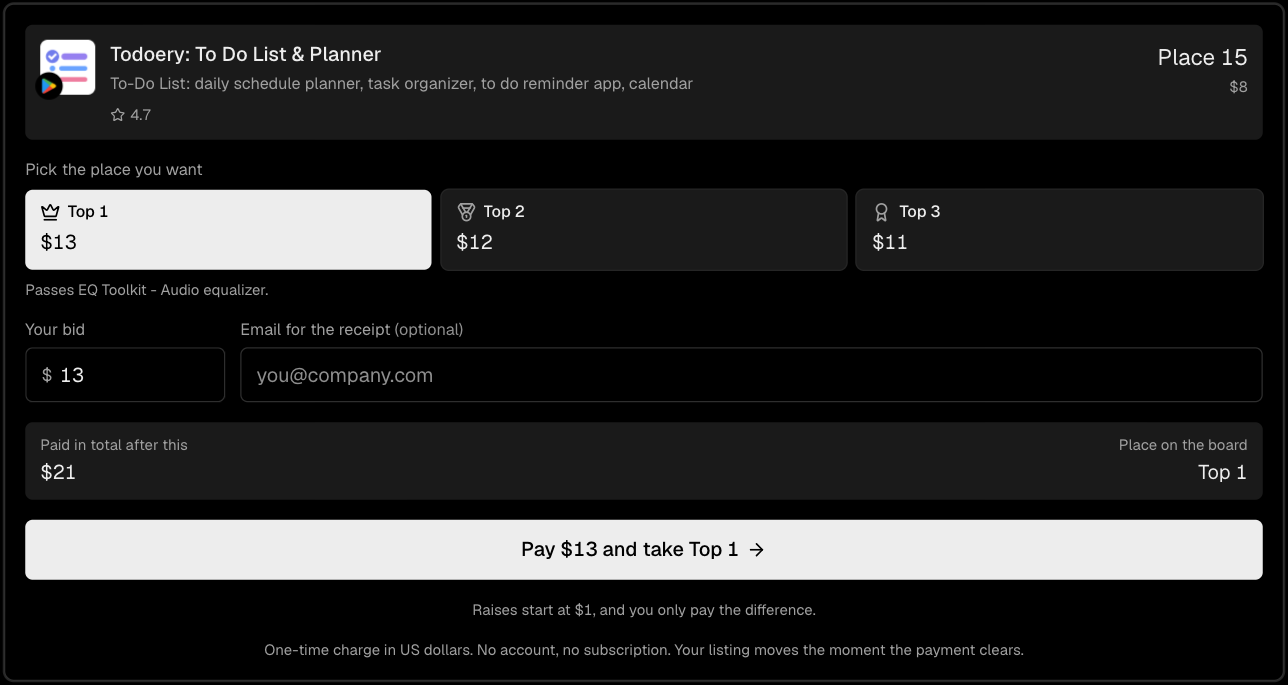
Raising a listing that already has $8 on it: the console asks $13 for first place, the gap to $21, not the full $21.
Ties keep their arrival order
Two listings can have the same total. When that happens, the one that got there first stays ahead. That tie-break is what sets the outbid step: matching someone's total is not enough to pass them, so passing a listing costs at least $1 more than it has paid.
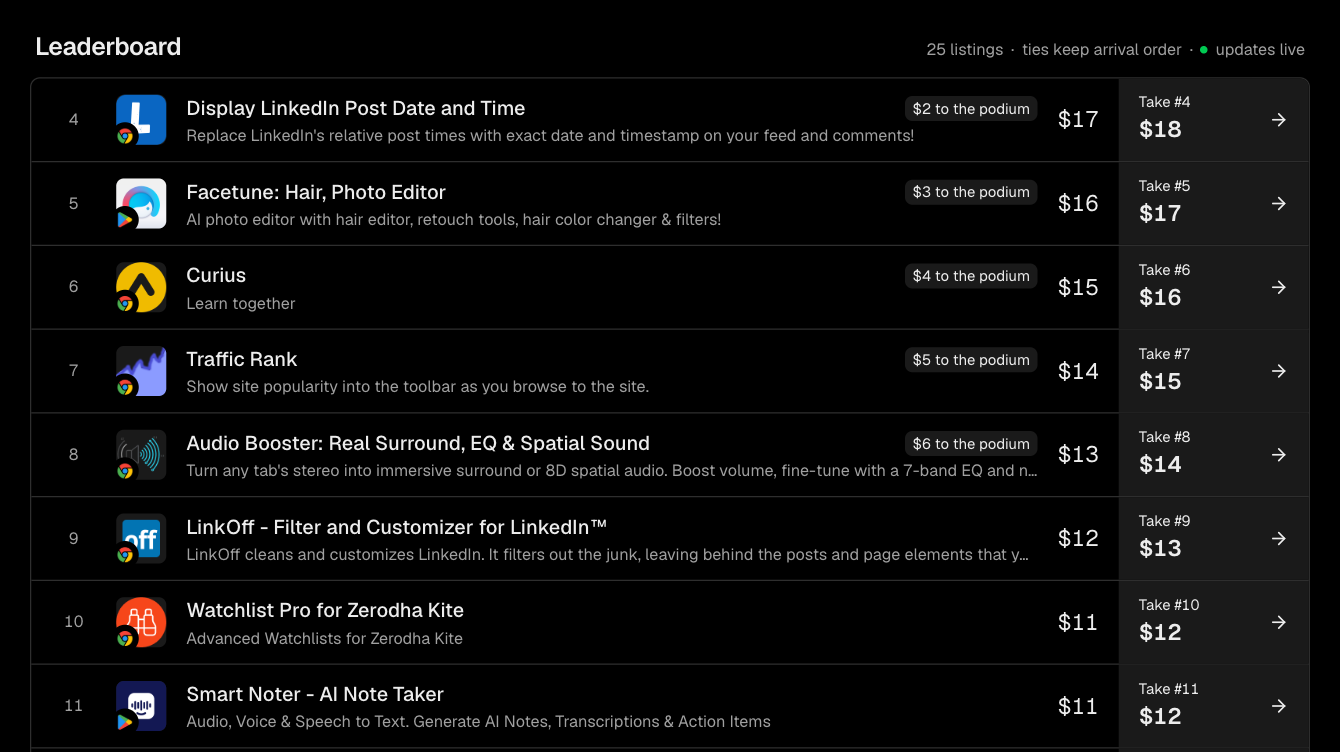
Places 10 and 11 both hold $11. The listing that reached $11 first stays ahead, which is why taking either place costs $12.
It also means there is no advantage in waiting and no race to the last second. A total you reach first is a total someone else has to beat, not merely match.
A rank is applied when the payment clears
A listing's total moves only when the payment provider confirms the charge, not when checkout opens. That has two practical consequences worth knowing before you buy.
First, two people can chase the same position at the same moment. Whoever's payment clears first gets it. The other buyer still gets exactly what they paid for, which is the amount added to their total, but not necessarily the rank they were aiming at.
Second, the board can lag a payment by a moment. If you have just paid and do not see the new total yet, give it a few seconds. A charge that clears and never reaches the board is one of the cases the refund policy covers in full.
Anyone can raise any listing
There are no accounts on AppRanker, and a listing is not owned by whoever created it. Everyone who pastes the same app lands on the same listing, and every payment on it adds to the same total. That includes people who are not the developer: a fan, a partner or a customer can put money on an app they like.
The flip side is stated plainly in the terms: money on a listing says that someone paid, not that the developer endorsed the payment, and not that AppRanker vouches for the app.
What rank is not
Because the rule is mechanical, it is worth being precise about what a position does and does not say.
Rank is not a review
The board is a public sort on money. It is not an endorsement, a quality signal, or a claim that any listed app is good. Listings are still held to the app stores' own rules: the board is swept monthly, reviewed more deeply every quarter, and anything prohibited by the stores is removed, with the money on it forfeited.
Rank is not a traffic promise
A position buys a place on the board, a listing page of your own, a share card and a row that links straight to your store page. It does not buy a number of clicks, installs or sales. Clicks are counted on AppRanker's own server so the counts stay honest, but they are never published beside a listing and never promised.
Sponsor cards are outside the sort
The labelled Sponsored cards beside and below the board are a separate product. A sponsor placement adds nothing to any listing's total and cannot move a listing by a single place. The board is sorted by what listings have paid, and nothing else.
Why a transparent rule is the point
A ranking you can reason about is a ranking you can plan around. If you are launching an extension or an app, you can look at the board, see exactly what third place costs today, and decide whether that is worth it to you. Nobody can quietly change the weighting next month, and nobody else can get a better deal on the same position.
That is the whole product. If you want to see where your app would land, paste its store link on the home page: every position shows its price before you pay.