- App promotion
- Indie makers
- Launch
Mobile app awards: which to enter, deadlines and fees
Mobile app awards for indie developers: which ones you can enter, which are chosen by editors, 2026-27 deadlines and fees, and how to spot pay-to-win awards.
AppRanker team10 min read
On this page
Mobile app awards arrive in a cluster at the end of every year. Google publishes its Best of Google Play list in November, Apple names its App Store Awards finalists and then winners around the start of December, and paid competitions like the Webby Awards hit their final entry deadlines in December. If you build apps, your inbox fills up at the same time with offers to "claim" an award you never entered.
Most of the awards worth having cannot be entered at all, and some of the ones that take entries are worth more than others. This guide sorts them out: which awards are picked by store editors and how to get on their radar, which take entries and what they cost, when each one happens, how to spot an award that is really a sales pitch, and what you are allowed to say once you win.
Key takeaways
- The App Store Awards, Apple Design Awards and Best of Google Play have no entry form. Editors pick the finalists. The way in is the stores' featuring nominations and a product they want to show.
- The Webby Awards take paid entries: from $105 for students to $835, with a general single entry at $525 early and $595 at the final deadline. The final deadline falls in December.
- Fan-voted and community awards, like the Pocket Gamer Awards for mobile games, cost nothing to be nominated for but reward the audience you already have.
- Treat any "award" that contacts you first and asks for a fee to accept it as marketing for the organizer, not for you.
- Google's store listing rules say not to put claims like "Best of Play 20XX" or "App of the year" in your listing text, so use a win on your website, press kit and social posts instead.
Two kinds of mobile app awards
Every app award falls into one of two groups, and the difference decides whether it is worth your time.
Editorial awards are chosen by the platform. Apple and Google pick from apps they already know, there is nothing to submit, and winning puts your app in front of store visitors for weeks. They are the ones that move installs.
Entry awards take a submission, usually with a fee. They range from long-running juried competitions with public voting to directories that hand a badge to anyone who pays. They mostly help with credibility and press, not with store traffic.
| Award | Who picks | Can you enter? | Cost | When |
|---|---|---|---|---|
| App Store Awards | App Store editors | No | Free | Finalists in November, winners in early December |
| Apple Design Awards | Apple | No entry form | Free | Finalists in May, winners in June |
| Best of Google Play | Google Play editors | No | Free | November |
| Webby Awards | Academy jury, plus a public People's Voice vote | Yes | $105 to $835 per entry | Final deadline in December, winners in April |
| Pocket Gamer Awards (games) | Fan nominations, then a fan vote | Anyone can nominate | Not stated | Nominations October to November, winners in January |
| Swift Student Challenge | Apple | Students only | Free | February 8 to 28, 2027 |
| Hackathons such as RevenueCat's Shipaton | Judges, partly on traction | Yes | Check each event | Varies |
Editorial awards: App Store and Google Play
App Store Awards
Apple's year-end awards cover iPhone, iPad, Mac, Apple Vision Pro, Apple Watch and Apple TV apps and games, plus Apple Arcade and a Cultural Impact category. In 2025, Apple announced the finalists in November and the winners on December 4: 17 apps and games that were "hand-selected by App Store editors from a list of 45 finalists for demonstrating exceptional innovation, user experience, and design." The iPhone App of the Year was Tiimo, a visual planner.
Apple Design Awards
The Apple Design Awards are announced around WWDC. In 2026, Apple introduced 36 finalists on May 18 and revealed the winners in June across six categories: Delight and Fun, Inclusivity, Innovation, Interaction, Social Impact, and Visuals and Graphics. The awards page describes each category but offers no way to enter.
Best of Google Play
Google's year-end list covers apps, games and books, with categories for the best overall app and game, devices (watches, large screens, cars, XR), and picks like Best Hidden Gem and Best Indie. The 2025 list was published on November 18, 2025, with Focus Friend by Hank Green as Best App. There is no form to apply.
How to get on the editors' radar
You cannot enter these awards, but you can make sure the people who choose them know your app exists:
- Use the featuring nominations. Apple's Featuring Nominations in App Store Connect and Google Play's featuring nomination form on Play Help are the official routes to editors. Our guides to getting featured on the App Store and getting featured on Google Play cover what each form asks for and when to send it.
- Ship platform features well. The Apple Design Awards categories reward accessibility, interaction design and visuals. Google's device categories reward apps that work properly on watches, tablets and cars. Doing one of these well is something an editor can point to.
- Keep quality signals clean. Ratings, crash rates and a current listing are the baseline for any editorial pick.
- Have a story. Apple's 2025 announcement describes every winner by what it does for people, not by its feature list. A press kit makes that story easy to reuse; see our app press kit guide.
Awards you can enter
Entry awards are a form and a fee; read the rules before either. Photo: RDNE Stock project / Pexels
The Webby Awards
The Webbys are the best-known paid competition that includes apps; winners are listed under Apps, Software & Immersive. The facts for the current, 31st season come from the Webbys' eligibility and fees page and season explainer:
- Eligibility. Ongoing work such as apps must be live when you enter, and it "does not need to have launched during the current season."
- Fees, early and final. Student $105 / $115, discounted categories $255 / $265, creator single $395 / $455, general single $525 / $595, software $645 / $715, and advertising campaigns $765 / $835.
- Deadlines. Entries opened on September 15, 2026 and the early deadline was October 30, 2026. The final deadline falls in December; for the previous season it was Friday, December 19, 2025. Fees become non-refundable after November 4, 2026.
- Judging. The International Academy of Digital Arts and Sciences, which the Webbys describe as a 3,000-plus member judging body, picks five nominees per category. Each category then has two winners: one chosen by the Academy and a People's Voice winner chosen by public vote.
- Timeline. Nominees are announced and People's Voice voting opens in early April 2027; winners follow in late April and the show in May.
Whether it is worth $595 depends on what you will do with a nomination. A People's Voice win needs an audience you can mobilize in April, and a nomination is useful mainly in press outreach and on your website.
Pocket Gamer Awards (mobile games)
For mobile games, the Pocket Gamer Awards are fan-driven. For the 2027 edition, anyone could nominate a game released between October 1, 2025 and September 30, 2026. Nominations closed on November 15, 2026, shortlists then go to a public vote, and the winners are due on January 19, 2027. Categories include Game of the Year, Best Indie Developer and Best Webshop. Because fans nominate and vote, the award favors games with an active community; it is a good reason to ask your players for a nomination next October.
Student and builder competitions
Two more are worth knowing about if they fit you:
- Swift Student Challenge. Apple announced on November 10 that the 2027 challenge is open February 8 to 28, 2027, and that students can now submit an app for any Apple platform.
- Hackathons with app categories. RevenueCat's Shipaton is the largest we found: its 2026 winners post reports 3,985 project submissions, almost 3,000 apps submitted to the App Store, Google Play and the Galaxy Store, and 58 winning apps. Its Grand Prize was judged on "what happened after an app shipped," using downloads, retention and revenue, which makes it one of the few awards that rewards traction rather than polish.
A mobile app awards calendar
Most app awards repeat on the same months every year. Photo: Towfiqu barbhuiya / Pexels
Based on the 2025 and 2026 dates above, this is roughly when each award moves. Check each organizer's page before you plan around a date.
| Month | What happens |
|---|---|
| September | Webby entries open |
| October | Webby early deadline; Pocket Gamer nominations open |
| November | Best of Google Play; App Store Awards finalists; Pocket Gamer nominations close |
| December | App Store Awards winners; Webby final deadline |
| January | Pocket Gamer Awards winners |
| February | Swift Student Challenge submissions |
| April | Webby nominees, People's Voice vote and winners |
| May | Apple Design Awards finalists |
| June | Apple Design Awards winners |
The editorial awards look back over the whole year, so the work that counts happens months earlier: a strong launch, a featuring nomination sent on time, and an update that uses the platform's newest features. Our guide to the best time to launch an app covers the seasonal side of that.
How to spot a pay-to-win award
Some "awards" exist to sell badges, trophies and listing upgrades. The warning signs:
- They found you. You get a congratulations email for an award you never entered, often naming your app as a "winner" or "finalist".
- Accepting costs money. A fee to claim the award, download the badge, or be listed on the winners' page.
- No named judges and no published criteria.
- Hundreds of categories or a winner in every niche, so that almost any app qualifies.
- No past winners you recognize, or past winners that are other small apps that also paid.
None of this means a paid entry is a scam: the Webbys charge an entry fee and publish their jury, fees and timeline. The difference is that you pay to be judged, not to be told you won.
What to do with a win
A real award is useful far beyond the badge, but the stores limit where you can mention it.
- In your store listing, follow the store's rules. Google's store listing best practices list "App of the year," "#1" and "Best of Play 20XX" among the claims a listing shouldn't include, and its metadata policy bans ranking claims in the app title, icon and developer name. Our Google Play description guide covers the rest of those rules.
- On your website and in your press kit, say it plainly, with the award's name, category and year.
- In outreach, a finalist spot or a win is a reason for a journalist to reply; our guide to writing a launch announcement has templates you can adapt.
- With the next nomination, mention it in your next featuring nomination to Apple or Google. Editors look for apps with a track record.
Awards versus paid visibility
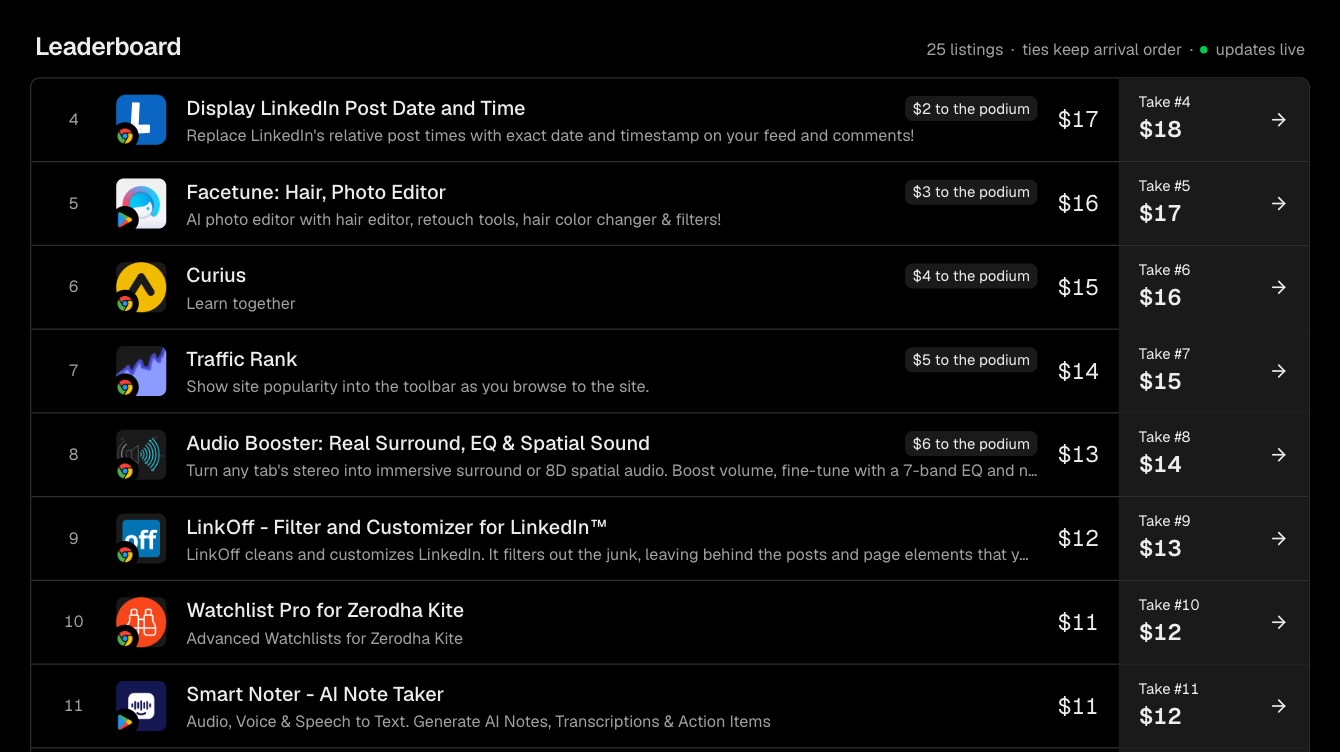
On AppRanker, each row shows what the listing has paid and what the position above costs.
Awards reward the apps editors and juries already like. Most indie apps will not win one this year, and they still need people to find them. That is where honest paid visibility fits: you pay, and it says you paid.
AppRanker is a pay-to-rank leaderboard for App Store and Google Play apps (and browser extensions), where rank is a plain sort on what each listing has paid and every row links straight to your store page. There is no jury and no "winner" email. Paste your App Store or Google Play link on the AppRanker home page to see what a position costs before you pay anything. For channels that cost nothing, see where to submit your app and our guide to promoting your app for free.
FAQ
Can I submit my app for the App Store Awards?
No. App Store editors choose the finalists and winners. The closest thing to applying is Featuring Nominations in App Store Connect, which tells editors about upcoming launches and updates.
How are the Best of Google Play winners chosen?
Google Play's editorial team picks them, and there is no application. You can tell Google about an upcoming launch through its featuring nomination form on Google Play Help, and keep your listing, ratings and technical quality in good shape.
How much does it cost to enter the Webby Awards?
For the current season, fees range from $105 (student) to $835 (advertising campaign) per entry. A general single entry costs $525 before the early deadline and $595 at the final deadline, which falls in December.
Are there mobile app awards for indie developers?
Yes. Best of Google Play has categories such as Best Indie and Best Hidden Gem, the Pocket Gamer Awards include Best Indie Developer, and builder competitions like RevenueCat's Shipaton judge apps partly on downloads, retention and revenue.
Can I mention an award in my Google Play listing?
Google's store listing best practices say listings shouldn't include text such as "App of the year," "#1" or "Best of Play 20XX," and the metadata policy bans ranking claims in the title, icon and developer name. Put the award on your website, press kit and social posts instead.
Is an award that asks me to pay a fee a scam?
Not always: legitimate competitions charge entry fees. Be wary when the award contacts you first, when you must pay to accept or display it, or when it has no named judges and no recognizable past winners.
Image credits
- Cover, five wooden stars on a blue background: photo by Ann H on Pexels, Pexels License. Cropped to 1200x630.
- Filling out a form on a laptop: photo by RDNE Stock project on Pexels, Pexels License. Resized.
- Calendar with red pins: photo by Towfiqu barbhuiya on Pexels, Pexels License. Resized.